Sometimes revisiting old things brings new understanding. Today, I reinstalled the Speech Blubs app on James’ iPad. He used to push it away. But this time, he stayed. He engaged, we laughed, we enjoyed it — and I felt something had significantly shifted, not in the app, but in us.
It may be small, but I am overjoyed. It was quiet proof that progress can return with exploration, persistence, and hope — the very things that truly help children with non-speaking autism.
AAC and Assistive Technology
AAC (Alternative and Augmentative Communication) is a set of tools and techniques for understanding how to support learners with speech, language, and communication differences. It includes valuing all forms of communication. Assistive Technology is one example of AAC innovation and how it can support teaching and learning.
Speech Blubs is an application designed to support home-based speech therapy using technology, and in this way, it serves as a learning tool to augment communication.
Assistive Technology applications that support speech generation, spelling and motor planning difficulties can expedite learning, offering pathways that might otherwise take a lifetime to build. In fact, Jane Korsten (2008) calculated that if an AAC user only learns during therapy, it could take 84 years to reach the same language exposure a typically developing toddler experiences naturally.
The significance of this is clear: exposure and immersion are vital. Every shared word, every modelled symbol, every small gesture counts.
If only one person models AAC, in a small room, for a few minutes a week, progress will always be slow. But if everyone — parents, teachers, peers, and communities — embraces it, the immersion that follows can transform understanding. That’s what inclusion really looks like.
Technology helps me find my own voice, too. Writing is my version of AAC — a way to make sense of what I can’t always say aloud. In this sometimes lonely space, the tapping of words becomes a kind of therapy — a reminder that connection happens through expression, not just speech.
Inclusion
We all come from different spaces of experience and education, yet the truth that shines through is that autism doesn’t discriminate — not by age, origin, ethnicity, or social status. What does create difference is access: access to understanding, to support, to opportunity.
Statistics show clear patterns — children from underprivileged or low-income families are often the ones most at risk of being left behind. Not because they lack potential, but because privilege opens doors that others must fight to find.
I’ve just finished my postgraduate certificate in Inclusion, and I’m still unravelling everything I’ve learned. The research gave me hope — but it also deepened my sadness. I see how much is lost when understanding and support come too late, or sometimes not at all.
“I didn’t choose to become a student of Special Needs; it doesn’t come easily. But we have to learn. It’s part of the job — and like any job, learning is the only way to do it well.”
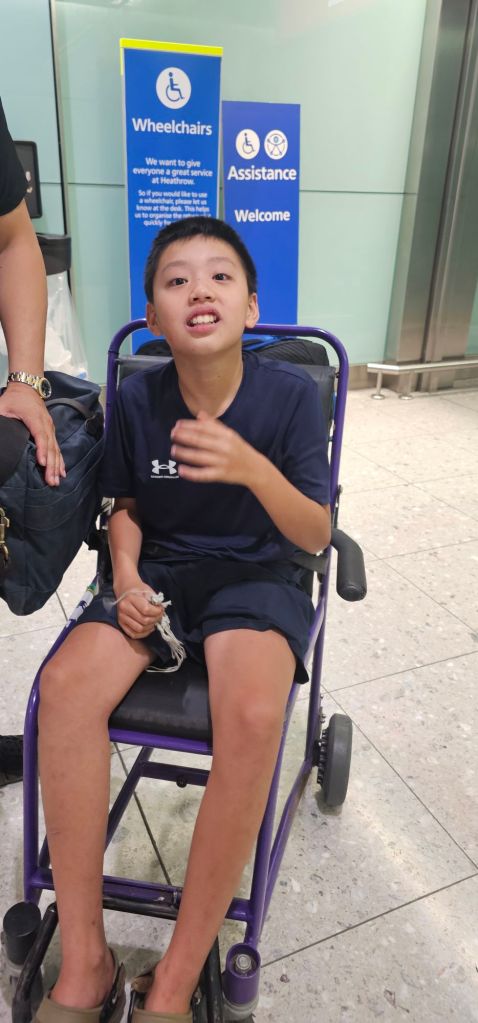
This post began as a joyful moment I shared online: a video of James and I signing in Makaton at Heathrow, with a caption that read:
“The world is changing in a magnificent way. We didn’t have these self-service wheelchairs in December, and now we do! The stress relief and anxiety reduction is immense. Happiness is peace, understanding, accommodation and acceptance.”
That change—wheelchairs available to borrow like luggage trolleys—sparked another thought.
When are we enabling agency, and when are we quietly reinforcing exclusion?
We’ve seen similar setups in supermarkets lately, the choice to help yourself without a lengthy registration process. It’s a small but powerful step toward everyday inclusion.
This was our first time using this service. Although I don’t plan to do it often or take advantage of it, I was grateful it was there. I want to encourage James to adapt when he can. But sometimes, circumstances dictate. And this time, it was the safer, easier, and kinder choice for both of us.
Still, I wondered if people were confused—seeing James in a wheelchair when he’s perfectly capable of walking. To be honest, I didn’t have time to worry about what others thought. He managed to dash off anyway. Specifically, he eloped.
Elopement
Eloping is the SEND (Special Educational Needs and Disabilities) term for this sudden, fast, unplanned running off. It’s a type of fight-or-flight behaviour often seen in autistic children, especially those with intellectual or learning disabilities.
Eloping, in the context of children with special needs, evokes a deep, instinctual panic. It is the kind that freezes your heart. It turns your stomach to stone. It happens in seconds. Your child slips from your grasp and bolts.
It’s not misbehaviour. It’s communication. Or it’s overload. Or it’s fear. Or sometimes, it’s just the only response a child has. We’ve experienced elopement in shopping centres, schools, restaurants, playgrounds. It’s scary. Avoiding these places altogether isn’t sustainable—or healthy. So we build a toolkit, and we remain alert.
Parenting or supporting a non-speaking autistic child with learning disabilities requires constant micro-decisions that are both ethical and practical. Each decision sits within a continuum:
Support vs. over-support
Protecting safety vs. restricting autonomy
Reducing demands vs. reducing opportunity
Adapting the world vs. unintentionally narrowing it
In this sense, inclusion is an ongoing negotiation. Families must continually evaluate the line between enabling agency and reinforcing passive dependence — a line that is influenced by risk, resources, social expectations, and their own emotional capacity.
Our airport ‘toolkit’
We don’t usually book special assistance services at airports, but we do carry a doctor’s letter explaining James’s needs. We book night flights. We pack familiar snacks and toys, print airport pictures in advance, and bring sensory items. Sometimes, I take anti-anxiety medication, not just for myself, but to ensure my fear doesn’t amplify his. That’s the hidden layer behind invisible disabilities and “He looks fine.”
Neurodiversity: Seeing the Bigger Picture
I sometimes prefer to talk about neurodiversity through characteristics rather than diagnostic criteria. From my own experience, I’ve found that the “defining characteristics” of autism have sometimes overshadowed James’s other learning needs—especially speech and language delay, apraxia, and global developmental delay.
Invisible or unseen can mean we often don’t know the full extent or cause—and we certainly can’t measure potential based on what we know so far.
The Unseen Population
There is a whole group of children and young people who rarely make it into the centre of conversations about autism, learning disability, or inclusion — not because they are small in number, but because they are harder for the world to see.
Children who don’t speak. Children without a reliable communication system. Children whose bodies don’t move the way they want them to. In classrooms, they are sometimes placed in the corner with good intentions, but low expectations. In society, they are praised when compliant, overlooked when curious, and misunderstood when distressed. None of these are the failures of the child. They are failures of our society and system.
There is still so little research into children without speech or formal communication. This population—those with the most complex disabilities—are often overlooked, omitted, or researched upon rather than with. They become theory, not fully recognised and respected lives.
Presuming competence sounds simple on paper. But in the real world, it bends and blurs. Capacity rises and falls with noise, hunger, fear, fatigue, environment, chemistry, chance.
Some days we stretch the world to meet our children. Some days we shrink their world to keep them safe. When are we nurturing agency — and when, without meaning to, are we teaching helplessness?
When are we opening doors — and when are we simply decorating the walls of a small room?
There is no universally “correct” position because every child and context is different. However, the critical question remains:
Are we creating conditions that allow the child to be an active participant in their life, or are we — intentionally or not — positioning them as passive recipients of care?
The difference between the two is profound. One supports growth, identity, and self-determination. The other reinforces the long-standing pattern in which disabled people are managed, spoken for, and ultimately viewed as objects of intervention rather than subjects of experience.
How does migration affect mental health and motherhood? And how can we prepare and protect ourselves from the risks we don’t always see coming?
We’re living in the age of globalisation. I was young when low-cost air travel exploded in the 1990s. Suddenly, flying became accessible to many more people—sometimes cheaper than a train ticket. Before then, migration tended to follow certain patterns: highly skilled professionals, intra-regional low-wage workers, or those seeking refuge.
But companies like EasyJet and Ryanair changed the game in Europe—making travel cheap, cheerful, and frequent. Migration became more casual, and cultural diversity more widespread. I think immigration and migration are great. It is fantastic to have the opportunity to experience different people and cultures.
I write this because mental illness can have many roots—and migration is one of them. As an expat, a mother, and an advocate for autism awareness, I think it’s important to explore how migration affects mental health, especially for families and parents of neurodivergent children.
My son is autistic. My family has a long history of migration. My grandparents migrated into a war zone. My parents later migrated out of one. And I became an expatriate myself when James was two.
Migration often means losing what feels familiar and safe. You trade family, structure, language, and predictability for the unknown. That uncertainty doesn’t always feel dramatic at first, but over time, it can chip away at your sense of stability and confidence. The social systems you once relied on—healthcare, education, childcare—are suddenly different, or gone entirely. You have to rebuild your support networks from scratch.
We moved to Thailand not long after my son’s diagnosis. But even before we left the UK, I was already feeling isolated. We had moved house in search of space for our growing family—a kind of local migration, but one that meant my nearest support was over an hour away by public transport. Motherhood had already brought challenges I hadn’t anticipated—and migration only magnified them.
Later, through James’ diagnosis, I began to recognise traits of neurodiversity in myself. As I explored autism and mental health more deeply, I started writing about them too. I wish I’d known more earlier—about the systems, the symptoms, and the ways neurodivergence and mental health can quietly intertwine. That’s why I now advocate for awareness, acceptance, and above all—prevention and preparedness.
There’s space, I believe, for better parental primary care. Not just post-partum, but pre-natal too. Especially for those who may already carry hidden or unspoken risk factors.
For me, mental health is a balance between physical wellbeing and self-awareness. I’ve found support in sharing my story, in connecting with others who understand, and in allowing myself space to reflect—without shame.
What helps:
1. Planning (especially around family) Before migrating, it helps to understand the healthcare landscape—not just in theory, but in practice. What does a paediatric appointment look like? Is there insurance coverage for developmental or mental health support? What sensory experiences might come up in a hospital setting? For me, the healthcare system in Thailand was nothing like the GP-led care I was used to in the UK. Language barriers, traffic, and unfamiliar systems all added stress when I was already stretched thin.
2. Support systems Online communities were a lifeline. The Expat Mummy Club, in particular, gave me space to find information and connect. Over time, more groups emerged—some focused on parenting, others on mental health or neurodiversity. These groups remind me that help can come from unexpected places.
3. Relaxation Finding calm isn’t optional—it’s essential. I try to choose activities that give my mind rest. It’s not always easy to notice what’s stressing you out, but recognising it is the first step. Learning to stay present—without constantly anticipating disaster—has helped me cope better, both as a person and as a parent.
4. Action plans (with flexibility) Plans do help—when I can write them. But I don’t punish myself if I can’t always follow through. Self-acceptance is key. I plan when I can, and when I can’t? I try to go gently. As my mum used to sing to me when I was little: que sera, sera. Whatever will be, will be.
This post is just one part of a much bigger conversation—about the mental health challenges that can arise with expatriate life, especially for families, and about the invisible layers that come with neurodiversity and motherhood.
As I prepare to join a panel to discuss neurodiversity and mental health, I hope to explore not just the difficulties—but the possibilities. How can we build systems of care that recognise complexity? How can we support parents before, during, and after migration—not just in crisis, but as part of meaningful, preventive care?
One topic close to my heart is Preparedness in Parenting. For me, it’s not about manuals or rigid frameworks. It’s about empowering parents with the awareness and tools to proactively navigate neurodiversity. How can systems become more inclusive, more compassionate, and more prepared? How can we foster stronger community connections and greater understanding for families in transition?
If any of this resonates with you, you’re not alone. Let’s keep the conversation going—across borders, across differences, and with compassion.
A reflection on agency, aggression, and the growth in between
I was going through old drafts and found a diary entry from four years ago. It shook me a bit to read it. In some ways, not much has changed. But in between, there has definitely been growth.
Our sense of agency is foundational to our mental and emotional well-being. It’s not just about taking action—it’s about choosing which action to take. Read more on agency: Inherent Yet Fragile
To avoid spiralling into reactive behaviour—my own or my son’s—I had to choose my response. Today, it was to consciously step into my spectrum and understand myself.
When I’m tired, I often feel unsure about how to engage with James, entertain him, or support his learning. This gets worse when we’re stressed, hungry, hot, or dysregulated.
I try to be consistent, while quietly battling a constant low-level anxiety:
Am I letting him stim too much? Is it helping? Hurting? Should I be doing more? Less?
The Crossroads of Parenting
I’ve been at a crossroads in my thinking for a long time. I want him to rest. His life has been full of therapy because I didn’t—and sometimes still don’t—know what to do. But the more I learn, the better our relationship becomes.
On tough days, though, I feel like I’ve been getting it wrong from the start. Mistake after mistake. Those thoughts keep me up at night. Sometimes crying. Sometimes fighting.
The diary entry from 2021 was an explosion of overwhelm into a screen. It brought back memories of the early COVID-19 pandemic. I’d had a miscarriage. We’d just moved house. I couldn’t shake the grief. And in the middle of it all, James began to self-injure. He would pinch himself, leaving red and purple marks across his skin.
Studying Inclusion, Feeling the Weight
In 2022, I began studying inclusion. I was becoming more confident, but also more frequently heartbroken. It was hard to detach from the raw vulnerability of children’s lives.
I’d been studying for years, but maybe I’d missed the key point.
A Moment of Aggression
It was a hot day. James asked to go down a street we’d never been on. Our routine was out of sync, Jonathan was travelling, and I was alone.
I said no. It was a busy road, and I was scared.
Thwack, thwack—there goes my head. Another time, he dug his fingernails into my face and pulled my hair. Then, moments later, he climbed into my lap and kissed me.
Forgiveness comes easily. But I know that I must help him. If I don’t support him in learning in the way he can, his independence will be limited.
Speaking Openly About the Hard Stuff
With hindsight, I wish the professionals who diagnosed James had found a way to reach me—and treat me at the outset too.
But truthfully, the diagnosis was a relief. It took away the weight of being labelled a “bad parent.” And it slowly helped me rebuild my confidence to act as a capable parent.
A diagnosis doesn’t mean despair or unhappiness. But still, I sometimes wonder if James’s childhood has been less joyful than I wanted for him. Maybe because of all the therapy. The systems. The watchful eyes.
I speak a lot about acceptance on my site. I allow myself to talk openly about the hard times, because I also celebrate our joy. But sometimes, I still feel paralysed. I feel like an imposter, dependent on medication to keep my brain in balance. Because when depression pulls the metaphorical trigger, it erases all the good and leaves me spiralling.
And I know these things impact James. They limit my ability to be the parent I want to be.
It’s my way of storytelling. A need to express connection, even without conversation.
This is me, sharing part of my spectrum. This is part of my advocacy for neurodiversity, for acceptance, for change.
If you’ve found yourself resonating with any part of this, then we’ve connected. Like listening to a song, passively yet deeply, and finding yourself inside someone else’s story.
It reminds me that emotions are fundamental to being human. That our experience of life exists on a spectrum, shaped by both nature and nurture.
My brain is also what makes me kind. Empathetic. Creative. Joyful.
And that joy is contagious. Most importantly, for James.
That’s the type of emotional contagion we need.
Innsaei
Back to today. I decided to trust myself. The Icelandic word for this is innsæi. James didn’t want to go to bed. Not many pre-teens do. I guessed that the day had simply been too full of demands for him. It was a bit difficult at first. We’ve been on a good run lately. But that’s life—ups and downs.
To cut a long story short, he reclaimed a tiny bit of agency. And so did I.
Beliefs shape how we see the world. Belonging shapes how we survive in it. And if we can’t always answer how, maybe we go back to why.
Today I attended a business workshop where we discussed passion, burnout, and bouncing back. It helped me connect some of the things that have been quietly sitting in my brain for a while: beliefs, belonging, burnout – and what comes next.
But let me backtrack. A new stim appeared today. I found myself wondering—was James trying to show something he couldn’t yet say? These are the kinds of questions I ask myself often. I overthink. But sometimes, that overthinking helps me notice patterns, to piece together signals that might otherwise go unseen. That brings me back to beliefs and burnout. I burn out because the load is heavy—juggling life, learning, teaching, and creating tools. Even things I love can weigh me down when there’s no room to pause.
Lately, I’ve been experimenting with AI tools—training image generators to create meaningful visuals for my projects. I hoped it would make things easier. The results are inconsistent: brilliant one moment, bizarre the next. In a way, it reminds me of autism and the term spiky profile. Like that term, these tools can be great in one area and miss the mark in another.
It also reflects something deeper: expectations.
We often expect people—especially children with additional needs—to “perform” to certain standards. We do this without pausing to understand the gaps in comprehension, communication, or cultural background.
Take a sandwich, for example.
If you give someone butter, bread, chicken, and egg, what do they make? That depends on where and how they were raised. Do they toast it? Does the butter go inside or outside? What goes first—the chicken or the egg? How would an untrained Artificial Intelligence Bot make it? (Ha.)
The point is: the “rules” are cultural. Learned. Assumed. Alien to some! Yet sometimes, experimenting outside those rules leads to something beautifully unexpected.
If the response is supportive—“that’s a creative idea,” or “tell me more”—it becomes part of a learning process. But if the response is “not like that” or “that’s wrong,” it can feel alienating. This can erode confidence. Imagine the frustration. Imagine facing that type of reaction with almost everything, all the time.
The challenge deepens when rules change depending on where you are too. I navigate language and systems in a culture that isn’t my own. My lifestyle doesn’t always fit the norm. The strain of not quite fitting in is something I feel often. This is especially true in this international world. Many of us are raising third-culture or even fourth-culture children. The layers add up. Different languages, different social cues, different systems. It’s no wonder burnout is common. Burnout isn’t just tiredness. It’s a state of mental, emotional, and physical depletion. It’s the slow erosion that comes from constantly adjusting to expectations that weren’t designed with you in mind. I see it in my child. I feel it in myself. And I read about it in parent communities.
I do overthink. I do burn out. But to counteract the signals, I’ve built myself a first-aid kit for those moments. I exercise, listen to music, read, sing, or work. I remind myself it’s okay to not be okay. It’s not perfect, but it helps. Sometimes I still hide. Tomorrow might be the day I’m a little less afraid.
Maybe the answer is simple: We are human. We evolve. We are the species that invented aircraft and landed on the moon. We can make life better for those living with depression or anxiety, or those who feel like they don’t belong. We can build systems of communication that meet people where they are. We can create roles and spaces that value what people bring, not just measure what they lack. People have the power to make meaningful change.
I write to make sense of it all—for myself, and for James. To find a way move beyond his current way of communicating. For every child and parent who feels like they’re getting the sandwich sign wrong, but keeps trying anyway.
And maybe, through it all, we can create a space for hope, answers, belonging, and a little magic. Maybe tomorrow that stim will have gone away. TBC 🙂
This post picks up from a recent Facebook post about singing, stimming, and choosing my battles (actually, not choosing to battle), touching on what it means to accept preferred behaviours—mine and my son’s—and the power of being present. A recent Uniquely Human Podcast on Neuro-affirming care and PDA brought these thoughts into sharper focus, so I wanted to reflect more here.
Looking at the title now, it could just as easily be a DIY home improvement post—and in many ways, it is. It’s about the rewiring we do as parents when we’re raising children who don’t fit into neat boxes. A personal repair.
From Pathology to Autonomy
Although I dislike the terminology of PDA (Pathological Demand Avoidance), the discussion struck a chord with me, particularly in the linguistic and diagnostic origins. Dr. Taylor Day pointed out that PDA is still a theorised profile, and that it’s the idea rather than the label that often best reflects lived experience.
Reframed as a Persistent or Pervasive Drive for Autonomy, the description feels closer to the truth. It shifts the focus from disorder to understanding. From behaviour to the influencing context. It invites the question—not “what’s wrong with this behaviour?” but “what is influencing this reaction?”
It’s Not Defiance—It’s Survival
Dr. Day spoke about PDA as a nervous system response: a cascading stress that affects the entire family. Not one trigger, but many, layered, compounding causes. A build-up in a hypersensitive system that’s on alert, that is fight or flight, freeze, fawn, overwhelm, and shutdown. All combinations of which can result in a state of chronic stress, often invisible, increasing over time, for both parents and children. She proposes it stems from insecurity. From my personal point of view, it has been panicking and not knowing what to do. And when that happens, demands and triggers of any kind can feel like too much.
The idea that some of our kids are “super sensors” feels closer to the truth. These are children (and adults) who are exquisitely attuned to tone, emotion, and stress, often without the capacity to regulate or respond in ways that look typical. And when they can’t comply, they get labelled as manipulative or defiant. It’s heartbreaking. They’re not trying to control the situation. They’re trying to survive it.
Reframing, for us
Dr. Day invited us to rethink how we make demands, and why. A child’s “big reaction” might be the result of years of subtle (and not so subtle) pressures, often unknowingly passed down by us.
In the same podcast, Dr. Barry Prizant asked: Who should really be teaching us? It is so easy for professionals to assume their way is best. Their language, their diagnosis, their model. But shared human experience is essential. As human beings, we all come with our own lens. Our own wiring. Lived experience is no less valid than academia. Lived experience doesn’t need a PhD to be valid. It’s valid because it has been lived, a space and truth beyond textbooks. It was refreshing to hear that acknowledged. And that’s where conversations like this matter. It is the bridge to better understanding, improved approaches, and pivotal and pragmatic steps forward in DIY therapy and empowered parenting.
Repairing the system, too
Looking back, so much of the early support we received was compliance-focused. Sit still. Tick the boxes three times consecutively to pass for normal. But at what cost? With hindsight, my neurodivergence is something I understand better now. This isn’t about blame. It’s about a review. About asking: Why did I think that was the right path? What parts of me were just trying to survive, too? Neurodivergence, Autism, and related challenges don’t discriminate. They touch every class, background, and IQ level. It’s not about capacity. It’s about support. There is no hierarchy. And there’s no universal “right way”—only ways that work (or don’t) for each individual. It is a phenomenon that we continue to learn how to approach, theorise, and try out.
Letting Go of “Normal”
The repair work I’m doing now is more about shifting the focus away from neurotypical benchmarks—function, assessment, normalcy—and asking: What actually helps him?
So many therapeutic models still frame success as compliance. We need to ask—what’s actually serving our child? Not what makes others comfortable. Not what ticks boxes or looks good on paper.
As my son enters the next phase of his life—physically the size of a man, on the edge of his teenage years—I think constantly about how the world can include him. He may need substantial support in daily life, but does that mean that life skills should be his priority? I’m more interested in developing his expression, communication, and preserving his youth. In nurturing self-advocacy. Of course, when safety isn’t the immediate concern.
He is where he is, in part, because of a larger inclusion problem. That’s why I keep doing this work: to keep changing how I see, how I respond, and how I show up for him.
Presence, Not Panic
One of the most powerful grounding tools Dr. Day shared was beautifully simple:
“Ask yourself, where are my feet right now?”
It’s so easy to live in the future as a parent, especially when your child’s future feels uncertain. What will happen when I’m gone? How will they cope? But anxiety steals the moment. And in the moment is where our children need us.
Instead of spiralling into all the unknowns, I try to focus on now. Enjoying our time together, and this sometimes means doing our own thing, but still checking in. Finding calm. This isn’t avoidance—it’s presence. And it’s powerful. It helps rewire my panic (neurological) pathways that have existed for a long time. It isn’t easy and it takes time, but the good news is that neuroplasticity can continue throughout our lives. Another leap of understanding in the field of neuroscience and neurobiology.
What really matters?
So instead of thinking in goals, guilt, outcomes, and “what should be,” I now try to think in contentment and connection. What helps my son feel safe? How can I support his autonomy? I turn to blogs, textbooks, and good news stories. And ultimately his behaviour tells me we are on the right track, for now.
Neurodivergent-affirming care starts with this:
Seeing the person in front of you as whole and worthy.
Understanding strengths and support needs, not just deficits.
Prioritising quality of life over performance.
Asking: Do they want to work on this? Not just: Do they need to?
This is respect and repair.
Not choosing battles—choosing peace
We hear a lot about “choosing our battles” in parenting. But maybe it’s time to step out of the battle altogether. If we see the stage our children are at, not as something to manage, but to meet with curiosity, then everything softens.
And it’s not just the child who needs care—we do too. Especially when neurodivergence runs in the family. Support needs to start with us, not end with us.
Uniquely Human Podcast
This podcast is full of insights—too many for me to cover here. I highly recommend listening to it. It’s one of those conversations that leaves you not with a checklist, but a shift in how you see things. And sometimes, that’s exactly what we need.
Adding “in-” in front of a word often seems to mean not. This is evident in examples like invisible (not visible) or incomplete (not complete). But language, like life, is full of exceptions and rule-breakers. Take different and indifferent: they don’t just mean “different” and “not different.” Indifferent actually means not caring or showing no interest, which isn’t the same as being the same. It’s about emotional disconnection or detachment.
Back to information. Information is not the negation of formation—it’s a formed piece of meaning. A fact or idea that’s taken shape, ready to be shared, understood, and used. And with that in mind, let’s use information to reframe how we think about neurodiversity.
Indifferent—or Just Different?
People with autism are often mislabelled as indifferent. Even worse, the once-popular puzzle piece symbol for autism suggests there is something missing—an incomplete puzzle. Sadly, this symbol is still in use.
But what if what looks like indifference is actually a difference in processing? What if it’s not a lack of interest, but a different way of showing it?
Can we truly remain indifferent—disconnected or detached—from that truth once we’re armed with better information?
What if we replaced that narrative with positive symbolism—symbols that advocate, assist, accommodate, and amplify acceptance of neurodiversity?
Introducing Interoception
The piece of information I want to share today is about interoception. It’s not a common word—appearing in only 0.2 occurrences per million words in modern written English—but it’s a vital concept, especially when parenting a neurodivergent child.
Interoception is your internal body awareness. It’s part of the somatic sensory system—the senses that relate to what’s going on inside your body, rather than outside. Interoception tells you:
When you’re hungry or thirsty
If you’re too hot or too cold
If you’re in pain or need the toilet
How tired, nauseous, or tense you feel
It’s the quiet feedback loop that connects your brain to your body, helping you regulate, respond, and self-care.
Why Interoception Matters
When interoception is underdeveloped or processed differently—as is often the case for many neurodivergent individuals—it can create very real challenges:
Emotional regulation
Managing discomfort or pain
Feeling safe and settled in your own body
Reaching learning potential
Understanding James’s interoception helps me understand his behaviour. It also allows me to reflect on my own interoceptive awareness. To support him, I need to tune into myself, too. This week I forgot to eat, didn’t sleep well, became overwhelmed and this fatigue followed me into the following days. I had less energy for him. So today I chose to stay at home, rest, recuperate and write. We’re learning together—co-regulating in tandem, decoding the signals our bodies send us in different ways.
Everything Is Information
Let’s return to the word everything. Everything = every thing. Each sound, sight, feeling, action—every sensory input is a piece of information.
So:
Every thing in the world is information.
If behaviour is a response to that information, then we must begin with understanding. Our behaviour is shaped by how we sense, interpret, and process the world. When we recognise that some behaviours stem from interoceptive or sensory differences, we can begin to rewrite the way we respond.
These behaviours may not signal defiance. They may not signal disinterest. They may simply be different responses to different internal information.
That understanding can change the way we teach, parent, and include.
When the Rules Don’t Fit
Learning is hard. And sometimes, the rules we rely on—social, educational, inherited, parenting, medical, textbook rules—don’t fit every child.
This is where we need a shift in thinking. Especially around our expectations of behaviour, communication, and connection. If we can look at autism and neurodivergence through a new lens—one shaped by compassionate information, not outdated assumptions—we may finally begin to:
Learn
Include
Accept
Instead of:
Diagnose
Pathologise
Exclude
Invisible Differences
Autism can sometimes be an invisible disability. Not because it’s not real, but because it doesn’t always show in the ways people expect. It can be invisible in the classroom, in the workplace, or even at home. Often, stigma, misunderstanding, or the quiet pressure to “mask” what’s not considered “typical” means autism stays hidden and repressed. And this invisibility is made worse by a lack of information or negative attitudes. When we don’t understand something, we often overlook it—or worse, judge it. But language and knowledge can change that.
From Information to Transformation
This post is an example of how language, meaning, and understanding evolve over time. Some ideas are inherited and taken for granted. That’s how many of us learned. But that’s not how everyone can—or should—be expected to learn. We can use better information to build greater understanding.
Because “in-” isn’t always a negation. And neither is autism. And information, like inclusion, is a celebration of something shaped, meaningful, and ready both to inform and to form.
While “invisible” or “incomplete” are negations, words like inspire, inform, inclusion, or incarnate don’t negate. Instead, they add depth, presence, or action. Both “inform” and “include” are generative acts. They don’t take away—they build, connect, shape. To inform is to give form. Autism isn’t a negation or absence—it’s not the lack of something but a different presence. This post suggests a new perspective. It aims to create a different approach. The shift is from deficit-based thinking to give form to value, diversity, and identity.
My hope is that by better understanding interoception, I can continue reshaping my own behaviour. I want to meet my son where he is. I aim to break down barriers, both personal and societal. To help James not just survive, but thrive, as we navigate this journey—together.
The work of thinkers like Dr. Joanna Grace helps us explore identity not as a fixed label, but as something multi-dimensional, evolving, and deeply connected to experience.
Here’s how James and I encounter and navigate these layers of identity:
Essentialist Identity: Our Inner, Unchanging Core
For James and I, our inner light was once dimmed by my struggle to truly understand his being, beyond the challenges of special needs parenting. In the early days of diagnosis and therapy, James was reduced to behaviours and diagnostic labels, which overlooked his true self. Yet, our joy, curiosity, and resilience exist beyond these external interpretations, and I’ve come to appreciate our existence more deeply as we navigate this journey together.
Structured Identity: How Our Environment Shapes Us
James and I are navigating an evolving understanding of a world that sometimes makes us feel different, abnormal, and excluded. The spaces we occupy shape us not only physically, but emotionally and socially as well. Access to disabled toilets, for instance, is a lifesaver for me. It means I can accompany James, who is almost as tall as I am, into the bathroom without being viewed as a potential risk to other children, simply because of his appearance. The environment and acceptance we encounter are influenced by many societal forces: from media representation and public understanding to legislation. These forces intersect to shape children’s growth, behaviour, emotional well-being, and inclusion.
Performative Identity: Adapting to Social Expectations
Performative identity explores how we adjust our behaviour to meet social expectations. Most people intuitively know how to behave in different settings—quiet in a library, more expressive at a party. For neurodivergent individuals like James and me, this social choreography isn’t always natural. When James flaps his hands or withdraws in busy places, it’s not misbehaviour; it’s communication. It’s his adaptive response to environments that don’t always cater to his needs. His actions are his language. Teaching him how to navigate these social scripts takes time, patience, and creativity.
This aspect of performative identity reminds us that we all perform to some extent. We have many roles —businesswoman, mother, sister, teacher, advocate—and the extent to which these roles affect our true selves is significant. Self-worth becomes central to the process of performing, especially when we feel pressured to act in ways that are not inherently true to who we are. For neurodivergent individuals, the process of being taught social skills can sometimes lead to masking, which can result in intense trauma. In these cases, the script needs to be rewritten, allowing for more authentic expressions of self.
Discursive Identity: The Power of Language
Language shapes how we see ourselves and how others perceive us. Words like “disordered,” “special,” or even “different” can unintentionally marginalise neurodivergent individuals. When we reflect on the evolution of language—terms like “retarded” or “spastic” that were once commonplace—we see the damaging impact of these labels, even when they were used with good intentions. For me, the label became James’s identity, and I admit there was a time I lost sight of his true essence. The words we use don’t just describe reality; they shape it. This is why it’s so important to choose our language carefully, to affirm rather than diminish the identities of others.
Phenomenalism: The Embodied Self
For individuals who are non-verbal or express themselves differently, Phenomenalism affirms that their inner world is real and present. Their movements, expressions, rhythms, and reactions are meaningful. These should not be dismissed as mere behaviour, but recognised as communication.
Joanna encourages us to engage with others in ways by learning to listen more deeply to alternative ways of being. Joanna’s work helps us go further. She teaches us not to judge a person’s worth by their physical or verbal capabilities alone. She urges us to understand that identity is a synergy of mind and body.
Beyond Identity: The Evolving Nature of Self
For James and I, our identity is lived through rhythm, repetition, emotion, and connection in tandem. His body is his language, and his sensory world is central to how he experiences and communicates who he is. Through this lens, his being and belonging are deeply tied to his sensory experience. This is why we need more inclusive spaces that recognise and accommodate the diverse ways people experience the world.
We are individuals, but we are also mother and son, and together, we share an embodied identity—one where I am his voice, his gateway to the world.
When we acknowledge that our identity is not fixed but deeply rooted in the present moment, and shaped by lived experiences, we can imagine a world where the environment evolves to accommodate every person’s needs.
In a nutshell, AAC, or Augmentative and Alternative Communication, refers to methods used by individuals who struggle with speaking or writing to express their thoughts, needs, and ideas. AAC doesn’t just facilitate communication; it promotes a different style of learning—one that places empathy at the forefront.
Low-tech AAC includes simple tools like pictures, visuals, or printed symbols. For example, a person might use a picture board with images of everyday items to communicate needs or wants. It can also include using a computer or camera to create or show visuals to aid communication. Low-tech solutions are accessible and easy to implement in various settings, offering an effective way to support communication without needing advanced technology.
No-tech AAC could be using everyday objects as symbols or objects of reference and body language. For instance, an individual might use the wrapper of a favourite food to signal a desire for that item. Additionally, facial expressions, basic gestures and Makaton (simplified, non grammatical sign language) are all important no-tech communication tools. These methods make use of what we already have at hand to communicate effectively.
High-tech AAC involves more advanced tools like speech-generating devices, applications, vocal output devices, switches or eye-gaze technology. These tools provide individuals with more complex and dynamic ways to communicate, offering them the ability to produce speech, text, or even control their environment. Vocal output devices can be particularly useful for individuals with severe communication impairments, giving them a greater degree of control over their interactions and choices. Equally, sophisticated speech-generating applications support language learning by reinforcing structure, syntax, and semantic coding — helping children build meaningful, grammatically rich communication. Speech-generating applications (SGDs) can support language development by organising vocabulary into categories and grammatical structures, tools to help reinforce sentence building. This structured approach allows children to form more meaningful, age-appropriate communication over time, even when spoken language is limited.
Switches other enabling devices For individuals with very impaired communication abilities, switches can offer opportunities to make choices and effect change in their lives. Switches are simple, accessible devices that allow users to make a selection or communicate by pressing a button. These can be connected to various devices, enabling a person to activate communication aids or control their environment, such as turning on a light or selecting a recorded message which enables a person to communicate basic needs or responses, such as saying “I want a drink” or “I need help,” with just one press of a button. These tools provide an invaluable opportunity for individuals who cannot use more complex speech-generating devices to still exercise choice and have a say in their daily lives.
Nowadays, there are inexpensive toys that allow you to record simple messages so this idea can be adapted to suit the individual.
In a nutshell, AAC is all about providing alternative ways for people with speech or language challenges to communicate effectively with others.
How can AAC aid learning for those with minor learning challenges?
AAC can play an important role in supporting individuals with minor learning challenges by helping them communicate and engage more effectively in their learning environments. Here are some of the ways it aids learning:
Improved Clarity and Expression: Whether using pictures or speech-generating devices, AAC helps individuals express their thoughts clearly, reducing frustration and promoting greater participation in classroom activities and discussions.
Support for Reading and Writing: For individuals with challenges such as dyslexia, AAC can assist with reading and writing by offering visual cues, word prediction, and text-to-speech options. These tools make it easier for students to access and express information.
Boosting Confidence: Many learners with communication difficulties may feel isolated or unsure of themselves in class. AAC methods, from picture boards to more advanced devices, offer them ways to engage and build confidence in their learning journey.
Reinforcing Concepts: Visual aids and symbols used in AAC can reinforce learning concepts, helping learners better understand and retain information. These supports can help break down complex ideas and make them more accessible.
Personalised Learning: AAC can be tailored to suit each individual’s unique needs. Whether using low-tech tools like pictures or high-tech speech-generating devices, AAC makes learning more accessible and ensures that students can engage in ways that suit their abilities.
Why would speaking people use it?
Speaking people might use AAC for several reasons, even if they can talk. Here are some common scenarios:
Temporary Speech Loss: For individuals recovering from surgery, illness, or injury (e.g., after vocal cord surgery), AAC can help them communicate while their speech returns.
Speech or Language Disorders: Some people have speech disorders like stuttering or aphasia (a condition that affects speech after brain injury), where AAC can serve as a backup or enhance communication.
Accessibility: In noisy environments or situations where speaking is difficult (e.g., in a loud crowd or during meetings), AAC devices can offer a clearer way to communicate.
Enhancing Communication: For some, using AAC can support more efficient communication, especially if they have specific needs or prefer to use visuals or text.
Multilingual Communication: AAC tools may be used to bridge language barriers between people who speak different languages.
In these cases, AAC can act as a useful tool to improve communication, clarity, and accessibility, even for people who are able to speak.
The evolution of child development theories is deeply connected to broader historical, biological, and technological changes that have shaped human societies.
The growing recognition of neurodiversity necessitates an ongoing reimagining of how we parent, teach, and learn. These changes highlight the importance of tools for connection, such as AAC (Augmentative and Alternative Communication), that facilitate and support children’s unique needs, helping them navigate and find meaning in a world that often requires adaptation.
From the early philosophical insights into childhood, through the scientific revolutions in biology and psychology, to the rise of inclusive educational practices and digital learning tools, our understanding of how children grow and develop has become more nuanced and interconnected. AAC, along with the many other frameworks that exist today, will continue to play a critical role in shaping a future where every child’s voice is heard, valued, and respected.
In a society that constantly evolves and challenges traditional norms, it’s critical to appreciate that each child’s developmental journey is unique—with tools like AAC, emotional intelligence, and inclusive education as vital support systems.
The Four-Pronged Approach to Human Development
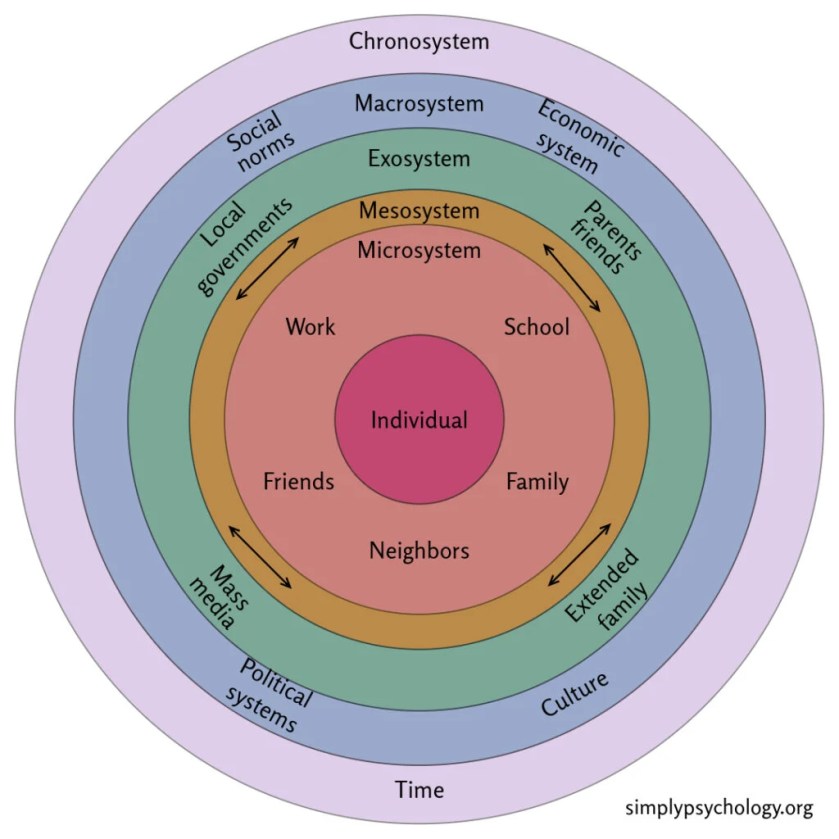
A great way to deepen our understanding of these interconnected factors is by exploring Urie Bronfenbrenner’s ecological systems theory, which outlines how children’s development is shaped by their interactions with different layers of their environment, from immediate family settings (the microsystem) to broader societal and cultural factors (the macrosystem).
A Bio-Psycho-Social-Societal Lens: Understanding the Whole Child
Biological: This focuses on physical growth, brain development, and genetics—basically, the body’s role in development.
Psychological: This covers emotional and cognitive development, how children form identities, and their inner world.
Social: This looks at the immediate environment—family, peers, and community—and how these relationships shape children’s behaviour and skills.
Societal: This examines the broader societal forces—like government policies, education systems, media, and cultural expectations—that influence a child’s opportunities and sense of self.
Stages, Conflicts, and Virtues
Erikson’s theory revolves around stages, conflicts, and virtues. The resolution of these conflicts leads to the development of virtues that serve as strengths throughout life. Below is a table of Erikson’s stages, the conflicts, and the resulting virtues:
Infancy (0-1)
Conflict: Trust vs Mistrust
Virtue: Hope
Early Childhood (1-3)
Conflict: Autonomy vs Shame/Doubt
Virtue: Will
Play Age (3-6)
Conflict: Initiative vs Guilt
Virtue: Purpose
School Age (7-11)
Conflict: Industry vs Inferiority
Virtue: Competence
Adolescence (12-18)
Conflict: Identity vs Confusion
Virtue: Fidelity
Early Adulthood (19-29)
Conflict: Intimacy vs Isolation
Virtue: Love
Middle Adulthood (30-64)
Conflict: Generativity vs Stagnation
Virtue: Care
Old Age (65+)
Conflict: Integrity vs Despair
Virtue: Wisdom
Erik Erikson’s psychosocial development theory is an essential framework for understanding how children navigate stages of growth. For neurodiverse children. Milestones such as trust, competence, or autonomy don’t always follow a neat, linear path for every child. For instance, children with autism may develop autonomy and competence in different ways, but they can still achieve these milestones. This is where AAC tools become invaluable. They provide alternative communication methods that allow children to express themselves in ways that are meaningful to them, ensuring that their developmental journey is accessible and inclusive.
Rather than seeing child development as a series of isolated stages or conflicts to be resolved, I believe it’s more helpful to acknowledge, identify, and address them as part of who we are at any given point in time. The goal is not to reach the highest stage of development for all. Personally, I value moments of isolation, as they provide space for reflection and self-awareness. Recognition of our capacity for conflict, resolution, and virtue is circular or even spiky, is my personal key to self-acceptance and self-actualisation.
Child Development Evolution timeline
Era: Pre-Industrial Era (Before 1700s)
Biological: Children were viewed as miniature adults, with no clear distinction for childhood.
Psychological: Emotional and cognitive development were overlooked; children worked from an early age.
Social/Societal: Family was central, education was minimal, mostly religious.
Key Philosophers & Thinkers: John Locke: “Blank Slate” theory (Tabula Rasa); Jean-Jacques Rousseau: Advocated for natural development, childhood as a time of freedom.
Era: Industrial Revolution (Late 1700s – 1800s)
Biological: Urbanisation led to public health advancements but increased exposure to illness.
Psychological: Darwin’s evolutionary theory reshaped understanding of human development.
Social/Societal: Progressive education emerged, with Dewey promoting experiential learning. Froebel introduced kindergarten. Child labour laws emerged; schooling systems expanded beyond religious institutions.
Key Philosophers & Thinkers: Charles Darwin: Theory of Evolution and Natural Selection; John Dewey: Progressive education and experiential learning; Friedrich Froebel: Founder of kindergarten, play as essential to development.
Era: Early 20th Century (1900s – 1950s)
Biological: Medical advances improved child health.
Psychological: Freud and Piaget revolutionised early childhood understanding. Freud’s psychoanalysis and Piaget’s cognitive stages shaped modern developmental psychology.
Social/Societal: Increased focus on early childhood education, with psychological theories influencing schooling.
Key Philosophers & Thinkers: Jean Piaget: Stages of cognitive development; Lev Vygotsky: Social-cultural theory, Zone of Proximal Development (ZPD).
Era: Late 20th Century (1960s – 1990s)
Biological: Advances in neuroscience and genetics led to recognition of developmental disorders.
Psychological: Erikson’s psychosocial stages highlighted identity and emotional growth.
Social/Societal: Focus on mental health, identity, and inclusion in educational settings.
Key Philosophers & Thinkers: Erik Erikson: Psychosocial stages of development; Jerome Bruner: Scaffolding, the role of social context in learning.
Era: 21st Century (2000s – Present)
Biological: Neuroplasticity and neurodiversity shape modern approaches to child development. Advances in medicine means those with Profound, Multiple and/or Complex Learning Disabilities are thriving beyond previous expectations.
Psychological: Emotional intelligence, as defined by Goleman, becomes a key developmental focus.
Social/Societal: AAC tools and inclusive education policies ensure developmental equity for all children.
Key Philosophers & Thinkers: Daniel Goleman: Emotional intelligence; Norman Doidge: Neuroplasticity, the brain’s ability to adapt; Stephen Hawking: Advocate for neurodiversity and inclusion.
Generation Overview, Impact and Mental Health
The generational shifts highlighted illustrate how the understanding of mental health, diagnoses, and special educational needs has transformed over the past century. This progression demonstrates how societal forces like economic conditions, media exposure, and technological advancements intersect to shape how we view children’s growth, behaviour, and emotional well-being.
The Role of AAC in Supporting Child Development
AAC tools as a tool for connection and inclusion enable us to go beyond teaching children to communicate more effectively. We are empowering them to navigate the world with empathy, understanding, and a deep sense of their own value. This aligns perfectly with Maslow’s view that self-actualisation comes not from achieving a singular, predefined goal, but from the freedom to express who we are and connect meaningfully with others.
AAC tools, whether they are high tech, low tech or no tech, are not just about learning or meeting educational requirements; they are tools for connection, transcending the national curriculum to create more meaningful relationships.
Maslow’s Hierarchy of Needs: Facilitating Self-Actualisation
Maslow believed that once our basic physiological and psychological needs—such as food, safety, belonging, and esteem—are met, we can then move toward fulfilling our fullest potential, which is self-actualisation.
For children with communication challenges, AAC tools serve as a bridge between meeting these foundational needs and realising their fullest potential. The ability to communicate freely and connect with others is crucial to fulfilling the need for belonging, which is the foundation of Maslow’s theory.
AAC doesn’t just facilitate communication; it promotes a different style of learning—one that places empathy at the forefront.
Chemical Exposure and Sustainability
In parallel with the rise of diagnoses and special educational needs, there has been growing concern about the impact of modern diets and chemical processes on mental health. The mass production of food, with an emphasis on processed ingredients, artificial additives, and high levels of sugar, has been linked to various developmental and mental health issues in children.
Increased exposure to chemicals such as plastics, pesticides, and artificial additives in food production has raised concerns about their effects on children’s neurological and cognitive development. Some studies suggest that exposure to these chemicals can lead to developmental delays, attention issues, and increased vulnerability to mental health conditions like anxiety and depression.
The increasing focus on mental health and special educational needs has led to significant changes in how children are supported in educational systems. Special education provisions have expanded greatly, with a growing understanding that children with neurodiverse conditions such as autism, ADHD, and dyslexia are not “broken,” but rather have different ways of experiencing and interacting with the world.
As we shift towards a more eco-conscious and sustainable future, the question becomes: how do we foster a world that nurtures children’s development in all aspects—biologically, emotionally, socially, and environmentally? As we address sustainability, it’s not just about saving resources or reducing waste—it’s about creating a world where children’s neurodiverse needs are understood, supported, and respected.
Call to Action
I’d love to hear your thoughts! Please share your experiences or reflections on how child development has changed across generations. How do you think these shifts will impact the next generation?
Reflecting on my own parenting journey and considering the influence of mass media and societal tools like parenting guides and Augmentative and Alternative Communication (AAC), it is clear how these tools and philosophies shape not only how we guide children but also how we understand their uniqueness in relation to their environment.
I think key to it all is the realisation that we all experience these virtues differently, depending on our position, stance, and outlook. This has a profound impact on how we understand neurodiversity and teach children. We are a product of a society that has imposed specific ideas, but we are also part of a society that challenges them.



 I am James' mum