
But He Looks ‘Normal’: Elopement, Autism, and Neurodiversity

This post began as a joyful moment I shared online: a video of James and I signing in Makaton at Heathrow, with a caption that read:

“The world is changing in a magnificent way. We didn’t have these self-service wheelchairs in December, and now we do! The stress relief and anxiety reduction is immense. Happiness is peace, understanding, accommodation and acceptance.”
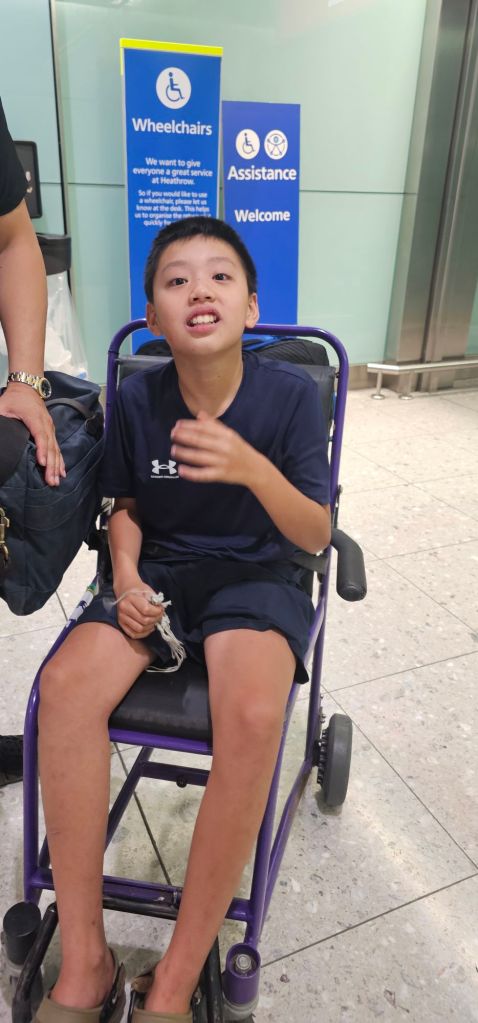
That change—wheelchairs available to borrow like luggage trolleys—sparked another thought.

When are we enabling agency, and when are we quietly reinforcing exclusion?

We’ve seen similar setups in supermarkets lately, the choice to help yourself without a lengthy registration process. It’s a small but powerful step toward everyday inclusion.

This was our first time using this service. Although I don’t plan to do it often or take advantage of it, I was grateful it was there. I want to encourage James to adapt when he can. But sometimes, circumstances dictate. And this time, it was the safer, easier, and kinder choice for both of us.

Still, I wondered if people were confused—seeing James in a wheelchair when he’s perfectly capable of walking. To be honest, I didn’t have time to worry about what others thought. He managed to dash off anyway. Specifically, he eloped.

Elopement

Eloping is the SEND (Special Educational Needs and Disabilities) term for this sudden, fast, unplanned running off. It’s a type of fight-or-flight behaviour often seen in autistic children, especially those with intellectual or learning disabilities.

Eloping, in the context of children with special needs, evokes a deep, instinctual panic. It is the kind that freezes your heart. It turns your stomach to stone. It happens in seconds. Your child slips from your grasp and bolts.

It’s not misbehaviour. It’s communication. Or it’s overload. Or it’s fear. Or sometimes, it’s just the only response a child has. We’ve experienced elopement in shopping centres, schools, restaurants, playgrounds. It’s scary. Avoiding these places altogether isn’t sustainable—or healthy. So we build a toolkit, and we remain alert.

Parenting or supporting a non-speaking autistic child with learning disabilities requires constant micro-decisions that are both ethical and practical. Each decision sits within a continuum:

  • Support vs. over-support
  • Protecting safety vs. restricting autonomy
  • Reducing demands vs. reducing opportunity
  • Adapting the world vs. unintentionally narrowing it

In this sense, inclusion is an ongoing negotiation. Families must continually evaluate the line between enabling agency and reinforcing passive dependence — a line that is influenced by risk, resources, social expectations, and their own emotional capacity.

Our airport ‘toolkit’

We don’t usually book special assistance services at airports, but we do carry a doctor’s letter explaining James’s needs. We book night flights. We pack familiar snacks and toys, print airport pictures in advance, and bring sensory items. Sometimes, I take anti-anxiety medication, not just for myself, but to ensure my fear doesn’t amplify his. That’s the hidden layer behind invisible disabilities and “He looks fine.”

Neurodiversity: Seeing the Bigger Picture

I sometimes prefer to talk about neurodiversity through characteristics rather than diagnostic criteria. From my own experience, I’ve found that the “defining characteristics” of autism have sometimes overshadowed James’s other learning needs—especially speech and language delay, apraxia, and global developmental delay.

Invisible or unseen can mean we often don’t know the full extent or cause—and we certainly can’t measure potential based on what we know so far.

The Unseen Population

There is a whole group of children and young people who rarely make it into the centre of conversations about autism, learning disability, or inclusion — not because they are small in number, but because they are harder for the world to see.

Children who don’t speak. Children without a reliable communication system. Children whose bodies don’t move the way they want them to.
In classrooms, they are sometimes placed in the corner with good intentions, but low expectations. In society, they are praised when compliant, overlooked when curious, and misunderstood when distressed. None of these are the failures of the child. They are failures of our society and system.

There is still so little research into children without speech or formal communication. This population—those with the most complex disabilities—are often overlooked, omitted, or researched upon rather than with. They become theory, not fully recognised and respected lives.

Presuming competence sounds simple on paper.
But in the real world, it bends and blurs.
Capacity rises and falls with noise, hunger, fear, fatigue, environment, chemistry, chance.

Some days we stretch the world to meet our children.
Some days we shrink their world to keep them safe. When are we nurturing agency — and when, without meaning to, are we teaching helplessness?

When are we opening doors — and when are we simply decorating the walls of a small room?

There is no universally “correct” position because every child and context is different. However, the critical question remains:

Are we creating conditions that allow the child to be an active participant in their life, or are we — intentionally or not — positioning them as passive recipients of care?

The difference between the two is profound. One supports growth, identity, and self-determination. The other reinforces the long-standing pattern in which disabled people are managed, spoken for, and ultimately viewed as objects of intervention rather than subjects of experience.

Mental Health, Migration, Mitigation and Motherhood

How does migration affect mental health and motherhood? And how can we prepare and protect ourselves from the risks we don’t always see coming?

We’re living in the age of globalisation. I was young when low-cost air travel exploded in the 1990s. Suddenly, flying became accessible to many more people—sometimes cheaper than a train ticket. Before then, migration tended to follow certain patterns: highly skilled professionals, intra-regional low-wage workers, or those seeking refuge.

But companies like EasyJet and Ryanair changed the game in Europe—making travel cheap, cheerful, and frequent. Migration became more casual, and cultural diversity more widespread. I think immigration and migration are great. It is fantastic to have the opportunity to experience different people and cultures.

I write this because mental illness can have many roots—and migration is one of them. As an expat, a mother, and an advocate for autism awareness, I think it’s important to explore how migration affects mental health, especially for families and parents of neurodivergent children.

My son is autistic. My family has a long history of migration. My grandparents migrated into a war zone. My parents later migrated out of one. And I became an expatriate myself when James was two.

Migration often means losing what feels familiar and safe. You trade family, structure, language, and predictability for the unknown. That uncertainty doesn’t always feel dramatic at first, but over time, it can chip away at your sense of stability and confidence. The social systems you once relied on—healthcare, education, childcare—are suddenly different, or gone entirely. You have to rebuild your support networks from scratch.

We moved to Thailand not long after my son’s diagnosis. But even before we left the UK, I was already feeling isolated. We had moved house in search of space for our growing family—a kind of local migration, but one that meant my nearest support was over an hour away by public transport. Motherhood had already brought challenges I hadn’t anticipated—and migration only magnified them.

Later, through James’ diagnosis, I began to recognise traits of neurodiversity in myself. As I explored autism and mental health more deeply, I started writing about them too. I wish I’d known more earlier—about the systems, the symptoms, and the ways neurodivergence and mental health can quietly intertwine. That’s why I now advocate for awareness, acceptance, and above all—prevention and preparedness.

There’s space, I believe, for better parental primary care. Not just post-partum, but pre-natal too. Especially for those who may already carry hidden or unspoken risk factors.

For me, mental health is a balance between physical wellbeing and self-awareness. I’ve found support in sharing my story, in connecting with others who understand, and in allowing myself space to reflect—without shame.


What helps:

1. Planning (especially around family)
Before migrating, it helps to understand the healthcare landscape—not just in theory, but in practice. What does a paediatric appointment look like? Is there insurance coverage for developmental or mental health support? What sensory experiences might come up in a hospital setting? For me, the healthcare system in Thailand was nothing like the GP-led care I was used to in the UK. Language barriers, traffic, and unfamiliar systems all added stress when I was already stretched thin.

2. Support systems
Online communities were a lifeline. The Expat Mummy Club, in particular, gave me space to find information and connect. Over time, more groups emerged—some focused on parenting, others on mental health or neurodiversity. These groups remind me that help can come from unexpected places.

3. Relaxation
Finding calm isn’t optional—it’s essential. I try to choose activities that give my mind rest. It’s not always easy to notice what’s stressing you out, but recognising it is the first step. Learning to stay present—without constantly anticipating disaster—has helped me cope better, both as a person and as a parent.

4. Action plans (with flexibility)
Plans do help—when I can write them. But I don’t punish myself if I can’t always follow through. Self-acceptance is key. I plan when I can, and when I can’t? I try to go gently. As my mum used to sing to me when I was little: que sera, sera. Whatever will be, will be.


This post is just one part of a much bigger conversation—about the mental health challenges that can arise with expatriate life, especially for families, and about the invisible layers that come with neurodiversity and motherhood.

As I prepare to join a panel to discuss neurodiversity and mental health, I hope to explore not just the difficulties—but the possibilities. How can we build systems of care that recognise complexity? How can we support parents before, during, and after migration—not just in crisis, but as part of meaningful, preventive care?

One topic close to my heart is Preparedness in Parenting. For me, it’s not about manuals or rigid frameworks. It’s about empowering parents with the awareness and tools to proactively navigate neurodiversity. How can systems become more inclusive, more compassionate, and more prepared? How can we foster stronger community connections and greater understanding for families in transition?

If any of this resonates with you, you’re not alone. Let’s keep the conversation going—across borders, across differences, and with compassion.

Step into my Spectrum

A reflection on agency, aggression, and the growth in between

I was going through old drafts and found a diary entry from four years ago. It shook me a bit to read it. In some ways, not much has changed. But in between, there has definitely been growth.

Today, the topic is aggression and agency.

Our sense of agency is foundational to our mental and emotional well-being. It’s not just about taking action—it’s about choosing which action to take.
Read more on agency: Inherent Yet Fragile

To avoid spiralling into reactive behaviour—my own or my son’s—I had to choose my response.
Today, it was to consciously step into my spectrum and understand myself.

When I’m tired, I often feel unsure about how to engage with James, entertain him, or support his learning.
This gets worse when we’re stressed, hungry, hot, or dysregulated.

I try to be consistent, while quietly battling a constant low-level anxiety:

Am I letting him stim too much? Is it helping? Hurting? Should I be doing more? Less?

The Crossroads of Parenting

I’ve been at a crossroads in my thinking for a long time.
I want him to rest.
His life has been full of therapy because I didn’t—and sometimes still don’t—know what to do.
But the more I learn, the better our relationship becomes.

On tough days, though, I feel like I’ve been getting it wrong from the start.
Mistake after mistake.
Those thoughts keep me up at night.
Sometimes crying. Sometimes fighting.

The diary entry from 2021 was an explosion of overwhelm into a screen. It brought back memories of the early COVID-19 pandemic.
I’d had a miscarriage. We’d just moved house. I couldn’t shake the grief. And in the middle of it all, James began to self-injure. He would pinch himself, leaving red and purple marks across his skin.

Studying Inclusion, Feeling the Weight

In 2022, I began studying inclusion.
I was becoming more confident, but also more frequently heartbroken.
It was hard to detach from the raw vulnerability of children’s lives.

I’d been studying for years, but maybe I’d missed the key point.

A Moment of Aggression

It was a hot day. James asked to go down a street we’d never been on.
Our routine was out of sync, Jonathan was travelling, and I was alone.

I said no. It was a busy road, and I was scared.

Thwack, thwack—there goes my head.
Another time, he dug his fingernails into my face and pulled my hair.
Then, moments later, he climbed into my lap and kissed me.

It’s difficult.

I know he is inherently good and that he needs to be taught.
Read more: on Presence not Panic

It’s hard to stay calm—and yes, I get angry too.

I can usually handle it.

The pain subsides. The bruises fad

The regret?
That’s harder to push away.

Forgiveness comes easily.
But I know that I must help him.
If I don’t support him in learning in the way he can, his independence will be limited.

Speaking Openly About the Hard Stuff

With hindsight, I wish the professionals who diagnosed James had found a way to reach me—and treat me at the outset too.

But truthfully, the diagnosis was a relief.
It took away the weight of being labelled a “bad parent.”
And it slowly helped me rebuild my confidence to act as a capable parent.

A diagnosis doesn’t mean despair or unhappiness.
But still, I sometimes wonder if James’s childhood has been less joyful than I wanted for him. Maybe because of all the therapy. The systems. The watchful eyes.

I speak a lot about acceptance on my site. I allow myself to talk openly about the hard times, because I also celebrate our joy.
But sometimes, I still feel paralysed. I feel like an imposter, dependent on medication to keep my brain in balance. Because when depression pulls the metaphorical trigger, it erases all the good and leaves me spiralling.

And I know these things impact James.
They limit my ability to be the parent I want to be.

Step Into My Spectrum

The title of this post comes from one of my favourite T-shirts:
Step Into My Spectrum.

It’s my way of storytelling.
A need to express connection, even without conversation.

This is me, sharing part of my spectrum.
This is part of my advocacy for neurodiversity, for acceptance, for change.

If you’ve found yourself resonating with any part of this, then we’ve connected.
Like listening to a song, passively yet deeply, and finding yourself inside someone else’s story.

It reminds me that emotions are fundamental to being human.
That our experience of life exists on a spectrum, shaped by both nature and nurture.

My brain is also what makes me kind.
Empathetic.
Creative.
Joyful.

And that joy is contagious.
Most importantly, for James.

That’s the type of emotional contagion we need.

Innsaei

Back to today. I decided to trust myself. The Icelandic word for this is innsæi. James didn’t want to go to bed. Not many pre-teens do. I guessed that the day had simply been too full of demands for him. It was a bit difficult at first. We’ve been on a good run lately. But that’s life—ups and downs.

To cut a long story short, he reclaimed a tiny bit of agency.
And so did I.