What is AAC?

In a nutshell, AAC, or Augmentative and Alternative Communication, refers to methods used by individuals who struggle with speaking or writing to express their thoughts, needs, and ideas. AAC doesn’t just facilitate communication; it promotes a different style of learning—one that places empathy at the forefront.

  1. No-Tech, Low-Tech, High-Tech approaches
  2. How can AAC aid learning for those with minor learning challenges?
  3. Why would speaking people use it?

No-Tech, Low-Tech, High-Tech approaches

Low-tech AAC includes simple tools like pictures, visuals, or printed symbols. For example, a person might use a picture board with images of everyday items to communicate needs or wants. It can also include using a computer or camera to create or show visuals to aid communication. Low-tech solutions are accessible and easy to implement in various settings, offering an effective way to support communication without needing advanced technology.

No-tech AAC could be using everyday objects as symbols or objects of reference and body language. For instance, an individual might use the wrapper of a favourite food to signal a desire for that item. Additionally, facial expressions, basic gestures and Makaton (simplified, non grammatical sign language) are all important no-tech communication tools. These methods make use of what we already have at hand to communicate effectively.

High-tech AAC involves more advanced tools like speech-generating devices, applications, vocal output devices, switches or eye-gaze technology. These tools provide individuals with more complex and dynamic ways to communicate, offering them the ability to produce speech, text, or even control their environment. Vocal output devices can be particularly useful for individuals with severe communication impairments, giving them a greater degree of control over their interactions and choices. Equally, sophisticated speech-generating applications support language learning by reinforcing structure, syntax, and semantic coding — helping children build meaningful, grammatically rich communication. Speech-generating applications (SGDs) can support language development by organising vocabulary into categories and grammatical structures, tools to help reinforce sentence building. This structured approach allows children to form more meaningful, age-appropriate communication over time, even when spoken language is limited.

Switches other enabling devices
For individuals with very impaired communication abilities, switches can offer opportunities to make choices and effect change in their lives. Switches are simple, accessible devices that allow users to make a selection or communicate by pressing a button. These can be connected to various devices, enabling a person to activate communication aids or control their environment, such as turning on a light or selecting a recorded message which enables a person to communicate basic needs or responses, such as saying “I want a drink” or “I need help,” with just one press of a button. These tools provide an invaluable opportunity for individuals who cannot use more complex speech-generating devices to still exercise choice and have a say in their daily lives.

Nowadays, there are inexpensive toys that allow you to record simple messages so this idea can be adapted to suit the individual.

In a nutshell, AAC is all about providing alternative ways for people with speech or language challenges to communicate effectively with others.

How can AAC aid learning for those with minor learning challenges?


AAC can play an important role in supporting individuals with minor learning challenges by helping them communicate and engage more effectively in their learning environments. Here are some of the ways it aids learning:

  1. Improved Clarity and Expression: Whether using pictures or speech-generating devices, AAC helps individuals express their thoughts clearly, reducing frustration and promoting greater participation in classroom activities and discussions.
  2. Support for Reading and Writing: For individuals with challenges such as dyslexia, AAC can assist with reading and writing by offering visual cues, word prediction, and text-to-speech options. These tools make it easier for students to access and express information.
  3. Boosting Confidence: Many learners with communication difficulties may feel isolated or unsure of themselves in class. AAC methods, from picture boards to more advanced devices, offer them ways to engage and build confidence in their learning journey.
  4. Reinforcing Concepts: Visual aids and symbols used in AAC can reinforce learning concepts, helping learners better understand and retain information. These supports can help break down complex ideas and make them more accessible.
  5. Personalised Learning: AAC can be tailored to suit each individual’s unique needs. Whether using low-tech tools like pictures or high-tech speech-generating devices, AAC makes learning more accessible and ensures that students can engage in ways that suit their abilities.

Why would speaking people use it?

Speaking people might use AAC for several reasons, even if they can talk. Here are some common scenarios:

  1. Temporary Speech Loss: For individuals recovering from surgery, illness, or injury (e.g., after vocal cord surgery), AAC can help them communicate while their speech returns.
  2. Speech or Language Disorders: Some people have speech disorders like stuttering or aphasia (a condition that affects speech after brain injury), where AAC can serve as a backup or enhance communication.
  3. Accessibility: In noisy environments or situations where speaking is difficult (e.g., in a loud crowd or during meetings), AAC devices can offer a clearer way to communicate.
  4. Enhancing Communication: For some, using AAC can support more efficient communication, especially if they have specific needs or prefer to use visuals or text.
  5. Multilingual Communication: AAC tools may be used to bridge language barriers between people who speak different languages.

In these cases, AAC can act as a useful tool to improve communication, clarity, and accessibility, even for people who are able to speak.
Child Development Through Generational Shifts

Child Development Theories: A Journey Through Time, Society, and Connection

The evolution of child development theories is deeply connected to broader historical, biological, and technological changes that have shaped human societies.

The growing recognition of neurodiversity necessitates an ongoing reimagining of how we parent, teach, and learn. These changes highlight the importance of tools for connection, such as AAC (Augmentative and Alternative Communication), that facilitate and support children’s unique needs, helping them navigate and find meaning in a world that often requires adaptation.

From the early philosophical insights into childhood, through the scientific revolutions in biology and psychology, to the rise of inclusive educational practices and digital learning tools, our understanding of how children grow and develop has become more nuanced and interconnected. AAC, along with the many other frameworks that exist today, will continue to play a critical role in shaping a future where every child’s voice is heard, valued, and respected.

In a society that constantly evolves and challenges traditional norms, it’s critical to appreciate that each child’s developmental journey is unique—with tools like AAC, emotional intelligence, and inclusive education as vital support systems.

The Four-Pronged Approach to Human Development

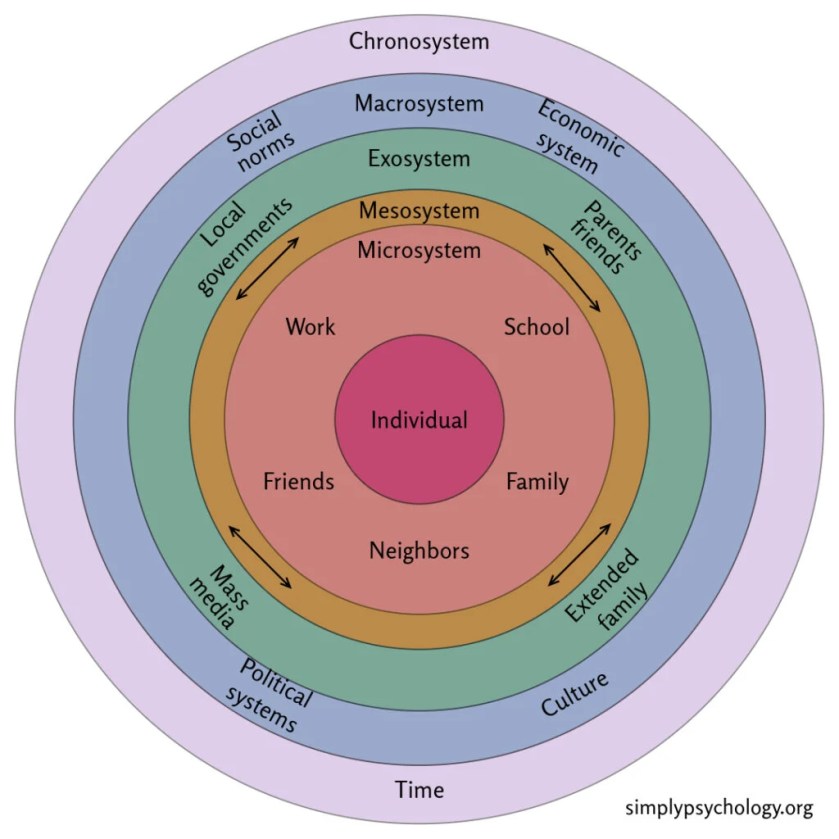
A great way to deepen our understanding of these interconnected factors is by exploring Urie Bronfenbrenner’s ecological systems theory, which outlines how children’s development is shaped by their interactions with different layers of their environment, from immediate family settings (the microsystem) to broader societal and cultural factors (the macrosystem).

A Bio-Psycho-Social-Societal Lens: Understanding the Whole Child

Biological: This focuses on physical growth, brain development, and genetics—basically, the body’s role in development.

Psychological: This covers emotional and cognitive development, how children form identities, and their inner world.

Social: This looks at the immediate environment—family, peers, and community—and how these relationships shape children’s behaviour and skills.

Societal: This examines the broader societal forces—like government policies, education systems, media, and cultural expectations—that influence a child’s opportunities and sense of self.

Stages, Conflicts, and Virtues

Erikson’s theory revolves around stages, conflicts, and virtues. The resolution of these conflicts leads to the development of virtues that serve as strengths throughout life. Below is a table of Erikson’s stages, the conflicts, and the resulting virtues:

Infancy (0-1)

  • Conflict: Trust vs Mistrust
  • Virtue: Hope

Early Childhood (1-3)

  • Conflict: Autonomy vs Shame/Doubt
  • Virtue: Will

Play Age (3-6)

  • Conflict: Initiative vs Guilt
  • Virtue: Purpose

School Age (7-11)

  • Conflict: Industry vs Inferiority
  • Virtue: Competence

Adolescence (12-18)

  • Conflict: Identity vs Confusion
  • Virtue: Fidelity

Early Adulthood (19-29)

  • Conflict: Intimacy vs Isolation
  • Virtue: Love

Middle Adulthood (30-64)

  • Conflict: Generativity vs Stagnation
  • Virtue: Care

Old Age (65+)

  • Conflict: Integrity vs Despair
  • Virtue: Wisdom

Erik Erikson’s psychosocial development theory is an essential framework for understanding how children navigate stages of growth. For neurodiverse children. Milestones such as trust, competence, or autonomy don’t always follow a neat, linear path for every child. For instance, children with autism may develop autonomy and competence in different ways, but they can still achieve these milestones. This is where AAC tools become invaluable. They provide alternative communication methods that allow children to express themselves in ways that are meaningful to them, ensuring that their developmental journey is accessible and inclusive.

Rather than seeing child development as a series of isolated stages or conflicts to be resolved, I believe it’s more helpful to acknowledge, identify, and address them as part of who we are at any given point in time. The goal is not to reach the highest stage of development for all. Personally, I value moments of isolation, as they provide space for reflection and self-awareness. Recognition of our capacity for conflict, resolution, and virtue is circular or even spiky, is my personal key to self-acceptance and self-actualisation.

Child Development Evolution timeline

Era: Pre-Industrial Era (Before 1700s)

  • Biological: Children were viewed as miniature adults, with no clear distinction for childhood.
  • Psychological: Emotional and cognitive development were overlooked; children worked from an early age.
  • Social/Societal: Family was central, education was minimal, mostly religious.
  • Key Philosophers & Thinkers: John Locke: “Blank Slate” theory (Tabula Rasa); Jean-Jacques Rousseau: Advocated for natural development, childhood as a time of freedom.

Era: Industrial Revolution (Late 1700s – 1800s)

  • Biological: Urbanisation led to public health advancements but increased exposure to illness.
  • Psychological: Darwin’s evolutionary theory reshaped understanding of human development.
  • Social/Societal: Progressive education emerged, with Dewey promoting experiential learning. Froebel introduced kindergarten. Child labour laws emerged; schooling systems expanded beyond religious institutions.
  • Key Philosophers & Thinkers: Charles Darwin: Theory of Evolution and Natural Selection; John Dewey: Progressive education and experiential learning; Friedrich Froebel: Founder of kindergarten, play as essential to development.

Era: Early 20th Century (1900s – 1950s)

  • Biological: Medical advances improved child health.
  • Psychological: Freud and Piaget revolutionised early childhood understanding. Freud’s psychoanalysis and Piaget’s cognitive stages shaped modern developmental psychology.
  • Social/Societal: Increased focus on early childhood education, with psychological theories influencing schooling.
  • Key Philosophers & Thinkers: Jean Piaget: Stages of cognitive development; Lev Vygotsky: Social-cultural theory, Zone of Proximal Development (ZPD).

Era: Late 20th Century (1960s – 1990s)

  • Biological: Advances in neuroscience and genetics led to recognition of developmental disorders.
  • Psychological: Erikson’s psychosocial stages highlighted identity and emotional growth.
  • Social/Societal: Focus on mental health, identity, and inclusion in educational settings.
  • Key Philosophers & Thinkers: Erik Erikson: Psychosocial stages of development; Jerome Bruner: Scaffolding, the role of social context in learning.

Era: 21st Century (2000s – Present)

  • Biological: Neuroplasticity and neurodiversity shape modern approaches to child development. Advances in medicine means those with Profound, Multiple and/or Complex Learning Disabilities are thriving beyond previous expectations.
  • Psychological: Emotional intelligence, as defined by Goleman, becomes a key developmental focus.
  • Social/Societal: AAC tools and inclusive education policies ensure developmental equity for all children.
  • Key Philosophers & Thinkers: Daniel Goleman: Emotional intelligence; Norman Doidge: Neuroplasticity, the brain’s ability to adapt; Stephen Hawking: Advocate for neurodiversity and inclusion.

Generation Overview, Impact and Mental Health

The generational shifts highlighted illustrate how the understanding of mental health, diagnoses, and special educational needs has transformed over the past century. This progression demonstrates how societal forces like economic conditions, media exposure, and technological advancements intersect to shape how we view children’s growth, behaviour, and emotional well-being.

The Role of AAC in Supporting Child Development

AAC tools as a tool for connection and inclusion enable us to go beyond teaching children to communicate more effectively. We are empowering them to navigate the world with empathy, understanding, and a deep sense of their own value. This aligns perfectly with Maslow’s view that self-actualisation comes not from achieving a singular, predefined goal, but from the freedom to express who we are and connect meaningfully with others.

AAC tools, whether they are high tech, low tech or no tech, are not just about learning or meeting educational requirements; they are tools for connection, transcending the national curriculum to create more meaningful relationships.

Maslow’s Hierarchy of Needs: Facilitating Self-Actualisation

Maslow believed that once our basic physiological and psychological needs—such as food, safety, belonging, and esteem—are met, we can then move toward fulfilling our fullest potential, which is self-actualisation.

For children with communication challenges, AAC tools serve as a bridge between meeting these foundational needs and realising their fullest potential. The ability to communicate freely and connect with others is crucial to fulfilling the need for belonging, which is the foundation of Maslow’s theory.

AAC doesn’t just facilitate communication; it promotes a different style of learning—one that places empathy at the forefront.

Chemical Exposure and Sustainability

In parallel with the rise of diagnoses and special educational needs, there has been growing concern about the impact of modern diets and chemical processes on mental health. The mass production of food, with an emphasis on processed ingredients, artificial additives, and high levels of sugar, has been linked to various developmental and mental health issues in children.

Increased exposure to chemicals such as plastics, pesticides, and artificial additives in food production has raised concerns about their effects on children’s neurological and cognitive development. Some studies suggest that exposure to these chemicals can lead to developmental delays, attention issues, and increased vulnerability to mental health conditions like anxiety and depression.

The increasing focus on mental health and special educational needs has led to significant changes in how children are supported in educational systems. Special education provisions have expanded greatly, with a growing understanding that children with neurodiverse conditions such as autism, ADHD, and dyslexia are not “broken,” but rather have different ways of experiencing and interacting with the world.

As we shift towards a more eco-conscious and sustainable future, the question becomes: how do we foster a world that nurtures children’s development in all aspects—biologically, emotionally, socially, and environmentally? As we address sustainability, it’s not just about saving resources or reducing waste—it’s about creating a world where children’s neurodiverse needs are understood, supported, and respected.

Call to Action

I’d love to hear your thoughts! Please share your experiences or reflections on how child development has changed across generations. How do you think these shifts will impact the next generation?

Reflecting on my own parenting journey and considering the influence of mass media and societal tools like parenting guides and Augmentative and Alternative Communication (AAC), it is clear how these tools and philosophies shape not only how we guide children but also how we understand their uniqueness in relation to their environment.

I think key to it all is the realisation that we all experience these virtues differently, depending on our position, stance, and outlook. This has a profound impact on how we understand neurodiversity and teach children. We are a product of a society that has imposed specific ideas, but we are also part of a society that challenges them.

As simple as ABC? (addressing barriers collectively…)

Addressing Access Barriers Collectively “To share a little of each other’s world so that all might gain through a broadening of their horizons” (Grace, 2020)

  1. Language, Interaction, and Being
  2. Collective Community Change Through Core Words
  3. Emotional Regulation and Well-Being
  4. Universal/Specialist Approach: A Path Forward
  5. Advocating for a Broader Understanding

Did you know that some groups globally do not have access to comprehensive communication and literacy education? Historically, this group of disabled individuals was termed ‘subhuman’ and ineducable. Thankfully, the mindsets that contributed to this bleak landscape for disabled people have changed substantially.

Yet, despite major advances in social equality and human rights for people with disabilities, many are still limited by either their capacity to learn or the methods in which they are being taught. In reality, it’s a combination of both.

My son is one of these children. He is the reason I read and research, advocating for collective consciousness and community change. I share my perspective as someone who is still trying to filter the pragmatics from the complexities encountered over the years, from one specialist to the next. After much exploration, we have finally settled upon inclusion as a universal/specialist approach to adopt and embrace.

My son is someone you could consider to be a ‘sensory being.’ This term, coined by Inclusion Specialist Joanna Grace, is used to describe individuals with multiple learning disabilities in a positive light—highlighting their primary experience of the world, which is sensory (Grace, 2017). While no label or terminology can fully encapsulate the essence of who a person is, this term is sufficiently descriptive of some of his abilities and challenges, and it can support a wider understanding of how to interact with him and others like him.

The core meaning of this term for me is being. According to the Oxford English Dictionary, “being” refers to the state of existing, a person or thing that exists, or the essence or nature of something. People with profound and multiple learning and physical disabilities exist and continue to live in a society that often misunderstands and mistreats them. The stories of abuse and neglect in care homes, at the most tragic end of the spectrum, are heartbreaking.

If my son is a ‘sensory being’ and I am a ‘linguistic being,’ we need to find a bridge. We must ‘share a little of each other’s world’ to both of our benefit. This helps us appreciate and celebrate each other’s essence, our humanity, our relationships, and our existence together. This brings us to core words and how they can be used collectively in the community to create that bridge.

Language, Interaction, and Being

By definition, the description ‘sensory being’ implies that language is elusive for this group of people. It highlights the delicate balance between using too much language or too little. Imagine being completely ignored on one end of the spectrum, or overwhelmed and confused by too many words and commands on the other. Where is the middle ground?

Observation, the selective use of core words, Intensive Interaction, and Augmentative and Alternative Communication (AAC) can be the bridge to understanding this balance. These techniques involve using fewer words but with greater meaning—focusing on the most important, essential vocabulary that can facilitate communication and connection.

Understanding where the child is in relation to the basic (typical) phases of communication development and function can help design the core words to use. For example, non-intentional communicators may use indiscriminate body motions, crying, smiling, or vocalisations. What should you look for? How is the communication related to a sensory responsiveness to something internal or environmental? When the child cries, what do they need? When the child smiles, what makes them happy? What sounds do you hear in their vocalisations—do they vary? How is the tone? What can we adjust in the environment to respond to their initial pre-intentional communication?

Core Words Modeling: Example core words could include: “I,” “see,” “you,” “hungry,” “tired,” “happy,” “hot,” “cold,” “thirsty,” “want,” “play,” “oh no,” “better,” “more,” “help,” “stop.”

These core words can offer children like my son the opportunity to express their needs, preferences, and desires.

Collective Community Change Through Core Words

The collective use of core words across communities can make a tangible difference. It means that children like my son don’t have to rely solely on a few specialists or carers for their communication needs. Over time, this creates a web of understanding, enabling people with sensory processing differences to experience consistent, meaningful interactions across various settings. It’s not just about teaching language—it’s about fostering mutual understanding.

This shifts the dynamic from a top-down “I speak, you listen” model to a more collaborative, two-way exchange of meaning.

Emotional Regulation and Well-Being

This approach doesn’t just benefit children with sensory or communication challenges—it can be adapted to support everyone across a broad spectrum of needs. When communities adopt inclusive practices, everyone gains by broadening their understanding of how people experience the world. Children with sensory processing differences often struggle with emotional self-regulation due to the mismatch between their sensory experience and their environment. Some responses to these frustrations manifest as self-injurious behaviours or physical reactions. By incorporating timely and fewer, well-chosen words and responses, we help them process their experiences in ways that feel safe and manageable.

One concrete example is the improvement in my son’s regulation when I observe he is feeling overwhelmed. With the use of core words and signs like “calm,” “quiet,” or “break,” I can observe my own physiological change in response to the imminently stressful situation, and regulate both his and my own emotions more effectively. This emotional vocabulary isn’t just about words—it’s about co-regulation, modelling, and giving him the tools to communicate complex feelings and navigate the world with more agency and confidence.

Research has shown that using techniques like Intensive Interaction or AAC can significantly improve emotional regulation, well-being, and communication, while supporting literacy development and addressing the challenges of isolation and frustration that often accompany communication difficulties.

Universal/Specialist Approach: A Path Forward

The inclusive, universal/specialist approach we’ve adopted is about meeting children where they are, regardless of their individual challenges. For my son, this means embracing both specialised interventions (such as speech therapy or sensory integration techniques) and community-wide approaches that empower everyone—adults and children alike—to communicate more effectively.

Advocating for a Broader Understanding

I speak from a place of lived experience. As a parent advocating for my son, I experience firsthand the overwhelming range of emotions that come with being misunderstood or trapped inside a mind and body without an outlet. I know that interpreting my son’s behaviour is not just about finding a right “way.” It’s a constant journey of learning and unlearning, filtering through the complexities of the systems around us to arrive at a place where inclusion, understanding, and respect are the foundation of how we interact.