Alexithymia – emotional blindness?

Not being able to see, perceive, judge, or be aware of something is often caused by genetics or environmental factors, rather than intentional choices. After all, who would choose to be blind?

Understanding Alexithymia: Emotional Blindness Explained

Alexithymia, derived from Greek with “alexis” meaning “no” and “thymos” meaning “emotion” or “mood,” translates to “no emotions” or “lack of words for emotions.” It describes a difficulty in identifying, understanding, and articulating one’s own emotions. Picture trying to describe a colour you’ve never seen—this is similar to the challenge faced by those with alexithymia when dealing with their feelings.

It is not listed as a mental health disorder, and could be viewed as a personality trait. It involves difficulty in recognising and expressing one’s emotional states, which can complicate communication and emotional connection with others. It’s important to note that alexithymia is not about willfully avoiding emotions but often results from a combination of genetic factors and early life experiences.

The Oxford Dictionary defines also blindness as “a lack of perception or judgement.” This metaphorical use of blindness also applies to alexithymia, which may arise from various influences or past experiences. It’s not a matter of deliberate ignorance but rather a complex interplay of personal and environmental factors.

If you know someone with alexithymia, it’s valuable to try to put yourself in their shoes and understand their perspective. Imagine how they perceive and process emotions, and approach them with empathy and compassion. Just as we would support someone with a vision impairment, offering understanding and tools to navigate their emotional landscape is crucial.

Coexistence with Other Neurological Differences

Alexithymia often coexists with other neurological and psychological differences, including:

  • Autism Spectrum Disorder (ASD): Many individuals with ASD exhibit traits of alexithymia. Both conditions can involve difficulties with emotional expression and social interaction. While alexithymia is not exclusive to ASD, individuals with ASD may experience heightened challenges in identifying and communicating their emotions.
  • Attention-Deficit/Hyperactivity Disorder (ADHD): People with ADHD might also show signs of alexithymia. The impulsivity and inattention associated with ADHD can impact emotional awareness and expression, leading to difficulties in understanding and managing emotions.
  • Anxiety and Depression: These mental health conditions often overlap with alexithymia. Individuals with anxiety or depression might struggle with recognising and articulating their emotional states, similar to those with alexithymia.

Overlapping Characteristics

Emotional Regulation: Both alexithymia and other neurological differences like ASD and ADHD can involve challenges in regulating and expressing emotions. Individuals may find it difficult to articulate feelings or might experience heightened emotional responses.

Social Interaction: Difficulties in understanding and expressing emotions can affect social interactions. This overlap is common in both alexithymia and conditions like ASD, where social communication and emotional cues can be challenging.

Sensory Processing: Some individuals with alexithymia might also have sensory processing differences. These sensory experiences can influence how emotions are perceived and expressed, linking with conditions like ASD or ADHD.

Recognising the uniqueness of each individual’s emotional processing, including those who are neurodiverse, is kind. Compassion can go a long way in fostering better communication and connection. By embracing these qualities, meaningful support can be offered to those facing the challenges of alexithymia.

Role models

Young role models with neurological differences, including those related to alexithymia, demonstrate that these traits do not preclude success or influence. Their visibility in popular culture and sports helps to challenge stereotypes and foster understanding. By recognising and celebrating these individuals, we can promote a more inclusive perspective on neurodiversity and emotional processing.

Billie Eilish is a prominent young role model who has openly discussed her experiences with neurodiversity, contributing significantly to discussions around mental health and self-acceptance. In interviews, Billie Eilish has described how Tourette Syndrome affects her, saying,

“It’s just a part of me, and it’s a part of a lot of people, and it’s nothing to be ashamed of.”

Her influence contributes to a more inclusive and empathetic society by breaking down barriers and encouraging acceptance of individual differences.

Why do I avert my eyes?

Do I avert my eyes because I have difficulty in reading the other’s mind or because I see too vividly?

Can you imagine being asked to shield your eyes because it makes someone else uncomfortable? It is hard to believe, but this is a true story. A young woman with visual impairment was asked to wear dark glasses. Her uncovered eyes looked different and made the viewers uncomfortable.

Her lived experience included repeatedly being asked to hide her disability. This was done to protect the comfort of others. It came at the expense of her own comfort. How sad. Sadder that it amplifies a larger debate about masking and social skills training.

And it raises questions about how some children are taught to navigate the world. A world with a list of everything they cannot do. Long lists of fabricated scenarios, tests, stepped instructions, sometimes completely separate from the real world and meaning. The world that values ideals and conformity over identity and contentment.

Why do I avert my eyes? I don’t anymore. I vaguely recall it being mentioned as a child. Perhaps I was shy. I am shy (introverted) and extroverted in fact, at different times. My memory is shocking, but I know I was never forced to look into anyone’s eyes.

The way I see it is if the brain can’t process sensory input efficiently, it goes into stress mode. This is why people with autism are known to look away, or not make eye contact. Could it be ‘Seeing too vividly’? This idea is part of a set of Perception-First based concepts. These are Sensory Processing concepts, which I support. Thus the brain primary response is physiological arising from senses we do not consciously control. These include breathing, digesting, or even sneezing.

Perception-First and Sensory Processing

Perception-First Processing prioritises the signals from the environment. It’s a knee jerk reaction. This may be due to the higher number of synapses in their neurology causing noise and overwhelm, or regulation. E.g I get very hot and cold quickly so I usually wear layers. When I can’t control it I get very uncomfortable and then other things start to bother me more. I am overly aware of everything. Depending on my health and energy levels, when this happens I literally cannot focus on anything else. My skin becomes itchy, my hands clammy, the noise is too loud, or the sun is too bright. I want to shut down and put my hands over my ears and eyes. I am having trouble regulating.

This is an example of an intense reaction. I am neurodivergent, I am also a functioning adult and parent to a child with special educational needs. So I have had to learn and keep learning ways to regulate these basic physiological responses. I have to find and remember the methods to control their intensity. This affects me, my child, and our surroundings.

Intense World Theory

It also links nicely to the Intense World Theory. If we perceive the world as too intense, we will shut down. We will put our minds and bodies into a safe mode.

It begins with being aware of our basic safety needs. We need to attend to these needs. Self-regulation is essential. Adjusting the environment promotes inner comfort and calm.

Application of Intense World Theory in Real Life

Intense World Theory can be applied in daily life. This is done by understanding that heightened sensory processing is an integral aspect of the autistic experience. Emotional intensity is also a key component.

Importantly these theories help refute the outdated Theory of Mind (ToM) idea supported by many autism researchers. The concept of Theory of Mind (ToM) suggests that people with autism are cognitively deficient. This is because their thought processes differ from others. It is not true. As not all autistic people are savant, not all will have a cognitive deficit. As people, we have the ability to learn, at different speeds and in different ways. Once we address challenges from our physiology, and the environment, we recognise capacity. From this perspective, we can expect that values and meaning can be attributed to feelings and actions. We can also attribute them to interactions just like anyone else, in a natural environment. Time and response can help us access capacity, and adjustments or added explanations as necessary.

So, why were children forced to look into people’s eyes as part of therapy? & How can therapists incorporate Perception First Sensory Processing and Intense World Theory into neurodiversity-affirming practices?

This is for another post 🙂

Key Aspects of Neurodiversity Acceptance

The shift towards neurodiversity acceptance is a crucial step in recognising and valuing cognitive diversity.

Overlapping Characteristics of Neurodiverse Conditions

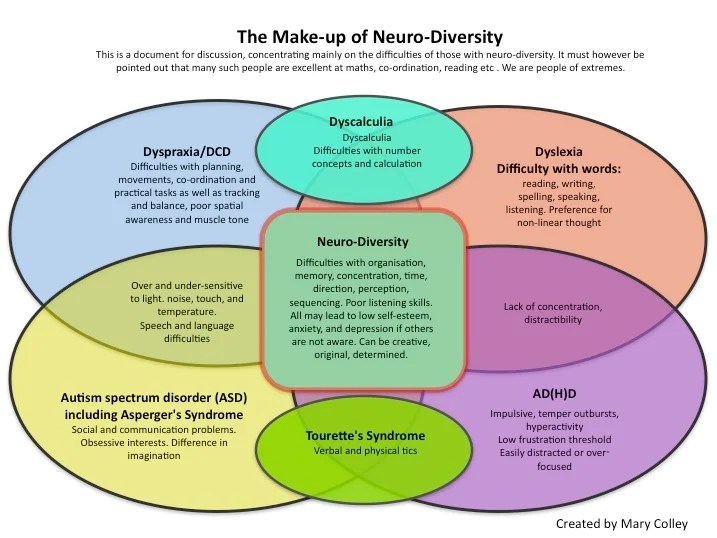
Neurodiverse conditions often overlap, and individuals may experience multiple learning differences. For example, dyslexia involves reading difficulties or differences. It may co-occur with dysgraphia, which refers to writing difficulties or processing differences. Dyslexia might also co-occur with dyspraxia, which involves motor coordination difficulties. Understanding these overlaps as processing differences and similarities can lead to more comprehensive and effective support strategies.

Research and Evidence-Based Practices

Research indicates that many neurodiverse conditions have a biological basis involving genetics, neurology, and neuroplasticity. Early identification of motor differences and other neurological factors can support positive outcomes. It is important to rely on evidence-based practices and consult credible sources to ensure the effectiveness of interventions and accommodations.

Building Supportive Communities

Creating spaces where neurodiverse individuals can connect and support each other is essential. Online forums and support groups offer valuable opportunities for sharing experiences and strategies. This peer support is crucial for fostering a sense of belonging and mutual understanding.

Building Supportive Practice

Positive Approach and Inclusive Education: Adopting a positive attitude towards neurodiversity can foster a more inclusive educational environment. Simple accommodations in schools and communities can significantly improve the educational experience for neurodiverse individuals. Examples include visual timetables, Makaton sign language, and voice output communication aids.

Collaboration Between Teachers and Therapists: A collaborative model can greatly benefit neurodiverse children. Teachers work closely with therapists to create effective support systems. This model ensures that educational practices are holistic and tailored to individual needs. The Swiss educational model includes Special Educational Needs Coordinators (SENCOs) in classrooms. It exemplifies effective collaboration.

Augmentative and Alternative Communication (AAC): AAC tools are essential for individuals who face challenges with spoken communication. These tools include speech-generating devices and eye-tracking technology. These tools not only aid communication but also support learning and social interaction. Universal integration of AAC can enhance inclusivity and recognition of diverse communication abilities.

I also propose an Integration of Inclusive Information, Communication, and Technology (IICT). Incorporating IICT into curricula encourages collaborative learning. It enhances technological proficiency. This approach highlights diverse learning methods. It uses technology to support all students, including those who are neurodiverse.

Further Reading and Resources

The Mary Warnock report champions the principle of inclusive education but with a nuanced understanding of various needs. It advocated for integrating students with special educational needs into mainstream schools. However, it recognised that full inclusion might not be suitable for every student. (link to Profound and Multiple Learning Disabilities, PMLD.

The document has the official title Special Educational Needs: Report of the Committee of Enquiry into the Education of Handicapped Children and Young People. It was published in 1984. It is a landmark document in the history of British special education. Commissioned by the UK government, it fundamentally reshaped the approach to education for students with special needs.

Historical Impact:

  • Inclusive Education: The Warnock Report marked a shift towards recognising the rights of all children. These rights include receiving an education that caters to their individual needs. It promoted the idea that all students should have the opportunity to learn. This includes those with difficulties, in a supportive environment.
  • Holistic Approach: The 40 Years On review advocates for a more holistic approach to education. It considers not just academic needs, but also emotional and social aspects. This reflects a broader understanding of what constitutes effective support for neurodiverse students.

  • Critique of “Velcro Assistants”: One of the significant contributions of the Warnock Report was its critique of the over-reliance on what it termed “velcro assistants” — teaching assistants who are permanently attached to a single child. The report argued that this practice could lead to a form of segregation and limit the child’s interaction with their peers. It highlighted that the role of a teacher, who is trained and qualified to deliver a broad and inclusive education, should remain central. The report stressed that the responsibilities of supporting students should not be solely passed onto less qualified teaching assistants. Instead, the role of teaching assistants should be to support teachers in implementing inclusive practices, not to replace them.

By shaping the landscape of special education, the Mary Warnock Report remains a cornerstone of British educational policy. Its legacy continues to influence how schools, educators, and policymakers address the needs of students with special educational needs, ensuring that the principles of inclusion and support remain at the forefront of educational practice.

  • The National Autistic Society
  • ACE Centre: Specialises in Augmentative and Alternative Communication (AAC) and Assistive Technology (AT).
  • American Speech-Language-Hearing Association (ASHA)
  • AAC Institute
  • By consulting these and other reliable sources, educators, parents, and professionals can ensure they are implementing the most effective and supportive strategies for neurodiverse individuals.
  • Social media influencers and prominent neurodiverse individuals can also play a vital role in advocating for acceptance and understanding.

Affirming Neurodiversity and Its Significance

Neurodiversity refers to the natural variation in brain functioning that encompasses differences in perception, information processing, learning, and social interaction. This concept includes conditions such as autism, ADHD, dyslexia, dysgraphia, and dyspraxia.

Embracing neurodiversity means recognising these differences as part of human diversity rather than viewing them solely through a lens of deficit or disorder. This blog briefly covers two psychological concepts that relate to affirming positive identities and self image.

Neurodiversity Acceptance: Building a Supportive and Inclusive Community

The movement towards neurodiversity acceptance is a profoundly positive shift in our society. It emphasises the value of diversity in cognitive functioning and the significance of recognising individuals on the autism spectrum and those with other neurodivergent conditions as unique and equal members of society, neurological differences that may manifest as processing challenges and learning differences. Aside from cognitive functions, equally important are the psychological processes that form in an individual being, relating to self-perception, emotional control, and mental health.

By fostering a community where neurodiverse voices can support each other, we create an environment where everyone, regardless of their abilities, can thrive. This movement is underpinned by several key aspects, including simple accommodations in schools and communities, the use of augmentative and alternative communication (AAC), and the promotion of neurodiverse role models and influencers.

Ensuring that labels are used constructively is crucial in promoting a positive self-perception in neurodiverse individuals. Adopting a positive attitude towards neurodiversity can foster inclusive communities, which can significantly improve the lived experience for neurodiverse individuals.

The Looking-Glass Self and the Self-Fulfilling Prophecy

The concept of the “looking-glass self,” introduced by sociologist Charles Horton Cooley in his 1902 work “Human Nature and the Social Order,” explores how individuals develop their self-concept based on their interactions with others. Cooley used the metaphor of a looking-glass, or mirror, to illustrate how people see themselves reflected through the perceptions and responses of those around them.

The concept of the “looking-glass self” by Charles Cooley highlights how the perception of others can impact self-image and self-worth.

The concept of the self-fulfilling prophecy was first introduced by sociologist Robert K. Merton he defined the self-fulfilling prophecy as a prediction or expectation that, by being made, causes itself to become true. This occurs because the belief or expectation influences behaviour in a way that brings about the expected outcome.

Embracing neurodiversity means recognising and valuing the differences in how individuals perceive, process, and interact with the world. By understanding and addressing the unique needs of neurodiverse individuals, we can create more inclusive communities and improve the quality of life for everyone. Through education, positive reinforcement, and evidence-based practices, we can support neurodiverse individuals in reaching their full potential and contributing their unique perspectives to society.

Practical Tips for Promoting Neurodiversity Acceptance

In Everyday Life:

  • Effective Communication: Use clear, straightforward language and avoid figurative speech that can be confusing for individuals with neurodiverse conditions. For example, instead of saying “think outside the box,” be specific about what you need.
  • Inclusive Practices: Promote inclusive behaviours by inviting neurodiverse individuals to share their perspectives and experiences. This can include adjusting meetings to accommodate different communication styles or ensuring that social events have options for quieter spaces.
  • Educate and Advocate: Engage in community education about neurodiversity. Share resources and support groups, and advocate for policies that promote inclusivity in schools and workplaces.
  • Celebrate Differences: Recognise and celebrate neurodiverse achievements and contributions. This can involve highlighting role models, acknowledging successes in community forums, or creating platforms for neurodiverse individuals to showcase their talents.